The monastery
The Brothers KaramazovThe monastery is a religious community near the town, but it is more than a setting for monastic life: it is the center of Elder Zossima’s spiritual authority and the place where the Karamazov family’s turmoil collides with religious discipline. Its celebrated elders draw pilgrims from across Russia, while its cells and refectory expose the distance between spiritual ideals and the unruly world beyond its walls. Alyosha’s departure, Zossima’s death, and the commotion over his body make the monastery a hinge between withdrawal and worldly responsibility, faith and disappointment, ritual order and public expectation.
The Monastery and Its Elders
The monastery’s standing rests chiefly on its elders, not on ancient relics, miracle-working icons, celebrated traditions, or historical exploits. Its fame has been made by living spiritual guides: pilgrims travel thousands of miles to see and hear them. The narrative therefore presents the monastery’s distinction as personal and relational. Its authority is embodied in the elder who receives visitors and guides their souls, rather than secured by outward signs of prestige.
The elder tradition is uncommon and has at times been treated in Russia as a persecuted innovation. It flourished especially at Kozelski Optin Monastery, but the narrator cannot say when or how it came to this monastery. Three elders had served there before Zossima, who is the last of them. By the time the family story reaches the monastery, he is gravely weakened by illness, and his succession is uncertain. The institution’s spiritual reputation thus depends on a tradition both influential and vulnerable: its reach is national, but its continuity rests on particular people and cannot be taken for granted.
Cells, Visitors, and Family Discord
The monastery’s spaces bring contrasting forms of life into close contact. Zossima’s cell is the setting for a gathering of the Karamazov family, a group so discordant that its meeting is arranged on a false pretext. The choice of an elder’s cell as the venue gives the encounter a charged setting: the family’s conflicts enter a place associated with guidance and spiritual discipline, but the sacred surroundings do not make the gathering harmonious.
The monastery’s authority also extends into the Father Superior’s rooms, where the family’s visit proceeds toward a formal dinner. Father Iosif, Father Paissy, and another monk are invited, alongside the visitors Miusov, Kalganov, Ivan, and Maximov. The limited scale of the Father Superior’s quarters contrasts with the social importance invested in the occasion. When Fyodor Pavlovich disrupts the expected proceedings with one of his pranks, the dinner becomes another demonstration that institutional decorum cannot contain the disorder the family brings with it.
This contrast is not simply between a virtuous monastery and a corrupt outside world. The monastery offers counsel and ritual, but its rooms become stages on which family resentments and comic disruptions are made visible. The community’s religious life gives the surrounding action a moral frame without instantly resolving the conflicts that enter it.
Alyosha’s Departure into the World
Alyosha’s connection to the monastery is practical as well as devotional. He helps the ailing Zossima to his small bedroom, furnished with only the bare necessities: an iron bedstead with a felt mattress and icons in the corner. When Alyosha asks to remain beside him, Zossima sends him instead to wait at the Father Superior’s table, where he will be more useful because there is no peace there. His instruction turns service away from the private comfort of the cell and toward the difficult gathering outside it.
Zossima also tells Alyosha that the monastery is not to be his permanent place. He must go into the world when the time comes. The direction is significant because it refuses to equate spiritual loyalty with enclosure: Alyosha’s vocation will be tested among people and conflicts, not protected by remaining in the elder’s room. Later, when Alyosha returns across the monastery grounds and through the pine wood to the hermitage, he is shaken by Zossima’s decision to send him away. He had understood the monastery as peace and holiness; the world appears to him as confusion and darkness. Yet he learns that Zossima is worsening, and the return to the cell brings him back into contact with the very vulnerability that makes the elder’s counsel urgent.
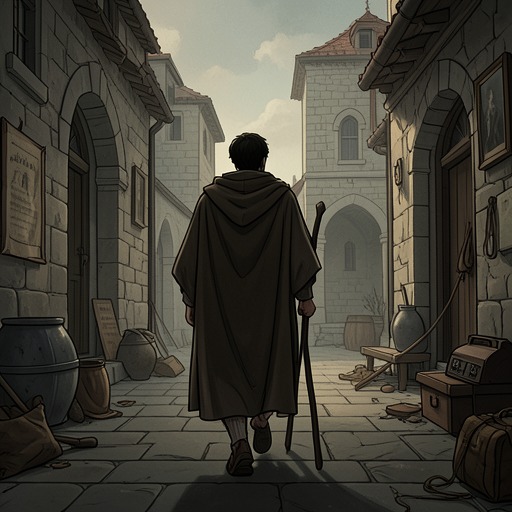
When Zossima again insists that Alyosha keep his promise to his father, brothers, and others, he assures him that he will not die before Alyosha can hear his last word. Alyosha leaves the monastery, and Father Paissy blesses him. As he departs, Alyosha recognizes in the austere monk a new and unexpected friend, a warmly loving teacher. His exit therefore does not sever his bond with the monastery; it carries its guidance outward. Within three days he has left in accordance with Zossima’s instruction to sojourn in the world.
Zossima’s Death and the Gathering Crowd
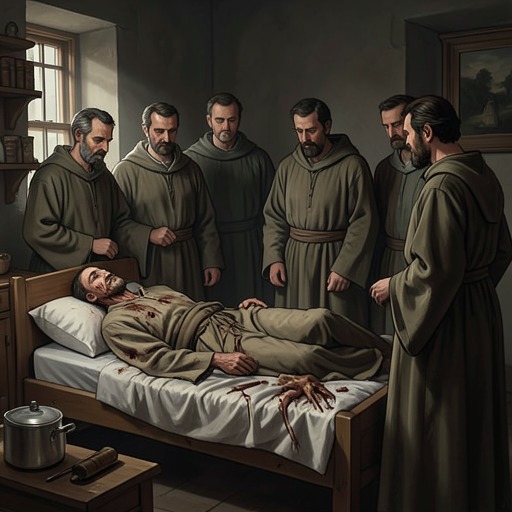
The monastery and its hermitage become the center of activity when Zossima dies. His death is described in the hermitage, where the news spreads at once to the monastery. The monks and those responsible for the rites begin preparing his body according to the established ritual. The movement from the hermitage to the monastery links private death with communal attention: what happens in the elder’s cell rapidly becomes the concern of the whole religious community and of visitors beyond it.
The body is prepared for burial under the customary rules for monks and hermits. Father Paissy wishes to read the Gospel over his dead friend through the day and night, but immediate practical demands intervene. The Superintendent of the Hermitage and Paissy must contend with an extraordinary excitement among the monks, visitors from the monastery hostels, and crowds coming from the town. As daylight grows, people begin bringing the sick. The monastery’s established ritual thus unfolds amid mounting expectation, as visitors look to the death of a famous elder for more than the ordinary observances of burial.
The crowd’s impatience sharpens the contrast between Zossima’s quiet death and the public meanings attached to him. In life, the monastery’s fame had gathered people around an elder who could speak and receive them; after his death, attention turns to what his body might signify. The institution must manage both the rite and the expectations that threaten to overwhelm it. The episode makes the monastery a place where devotional belief becomes public pressure, and where the limits of ritual authority are exposed by the crowd’s hunger for confirmation.
A Threshold Between Seclusion and Society
Across these episodes, the monastery’s meaning changes with the action around it. It is at once a community with a distinctive elder tradition, a setting for the Karamazovs’ discord, a place of service and formation for Alyosha, and the center of a public disturbance after Zossima’s death. Its enclosed spaces do not seal off worldly conflict: family feuds enter the cell, social commotion reaches the Father Superior’s dinner, and a crowd from town presses toward the hermitage.
Alyosha’s departure gives the monastery its clearest narrative function. It is the place from which he receives direction, but not the place where that direction is meant to remain. Zossima’s final counsel sends him toward responsibility among others, while the elder’s death and the commotion afterward show how fragile the monastery’s public prestige can be when spiritual authority is measured by signs and expectations. The monastery stands between retreat and engagement: its elders shape lives beyond it, yet the consequences of that teaching unfold in the world to which Alyosha is sent.